“Can we just make quoting a little easier?”
It sounds like a small request. Then someone mentions repeat orders, special pricing, delivery charges and the customer who always needs an exception. Suddenly the useful question isn't how quickly AI can build a screen. It's which version of “easier” everyone has agreed to buy.
For an Odoo consultant, the difficult part often sits between the client's everyday language and the behavior a developer needs to implement. AI can help produce a first version. It cannot settle an unspoken business disagreement.
Put one awkward quote on the table
Consider a fictional workshop that wants a quoting helper. The owner expects delivery to be included. The sales team treats delivery as a separate charge. Both can honestly describe their preferred result as a correct quote.
AI-generated editorial illustration—not product hardware or a screenshot.
Before generating anything, write down one ordinary example and one exception. Agree the expected result with the person responsible for the rule. Include what should happen when required information is missing.
That isn't paperwork for its own sake. It gives the client something concrete to approve and the builder something concrete to challenge.
A promise such as “AI will handle our quoting” is difficult to test. “This example includes delivery once, and missing delivery information requires review” is much more useful.
Ask the AI to expose its interpretation
The documented workflow behind the new Noodle Build includes project files, proposed edits and an app preview. A consultant can use those surfaces to investigate how a small helper implements an agreed example, rather than judging it only by its finished screen.
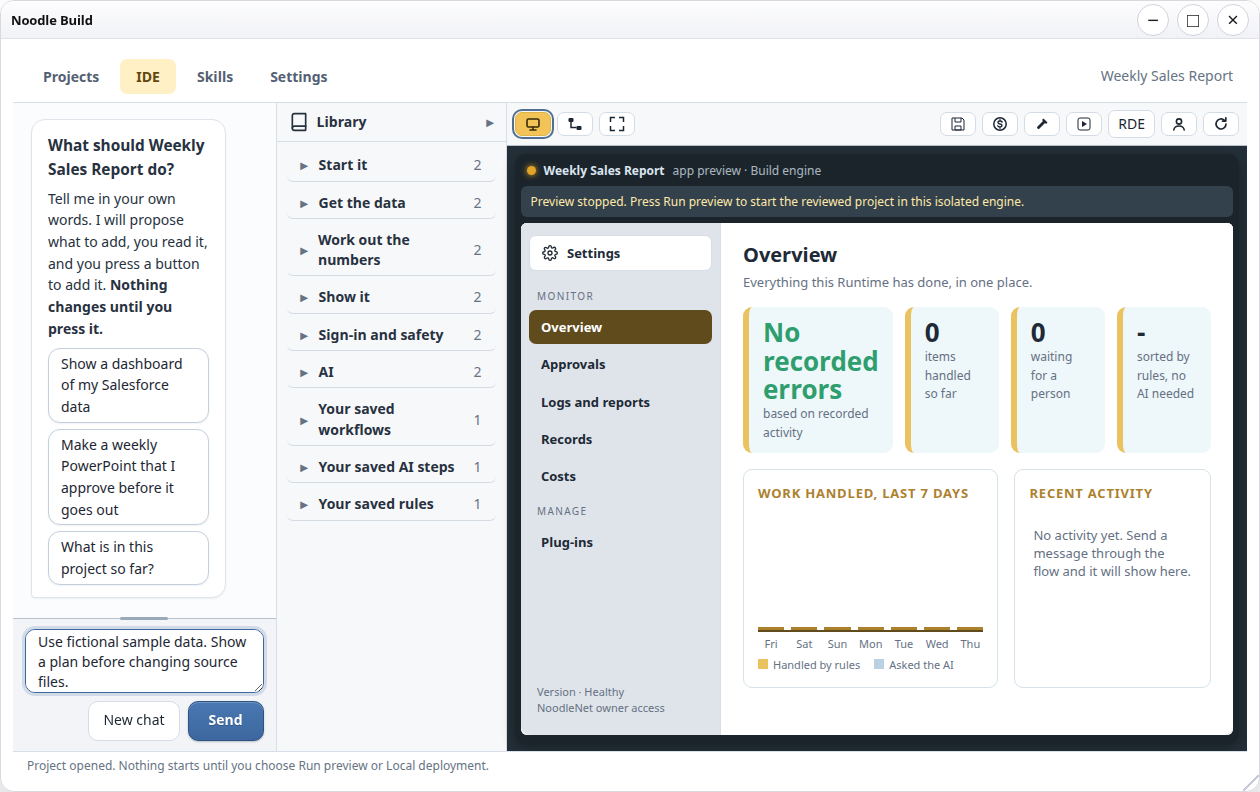
Current Build example workspace. The request is unsent; this is not a generated customer result. Controlled test session; fictional examples.
AI-generated editorial illustration—not product hardware or a screenshot.
Ask for a plain-language explanation of the rule. Compare it with the proposed change and the example result. If the explanation says one thing and the calculation does another, the project hasn't passed simply because the interface looks tidy.
This is a development approach, not a claim of completed Odoo integration. A separate helper, a connector description and a production customisation are different things. Actual integration still needs its own version, access, behavior and support checks.
Price the responsibility, not just the first draft
An AI-generated first version can create the impression that the remaining work is trivial. Sometimes the remaining work is deciding who owns the rule, checking an exception and supporting the result after the client changes a process.
Name the person who approves the business behavior. Name the technical reviewer. Agree what happens when an example fails and who maintains the helper after handover.
Don't attach a savings figure to a demonstration. First find out whether the proposed workflow solves the client's actual problem without shifting hidden work onto another person.
Make the first commitment small enough to understand
A sensible starting point is one bounded helper, fictional or authorised example data, an agreed acceptance check and a clear decision about what happens next. It need not alter live business records to teach the team something useful.
Noodle Build is now the official development workspace, formerly called Noodle Studio. Its Projects, Dev Agent and IDE give a team a shared place to develop and inspect a bounded helper. That is not proof that a particular Odoo integration or imported project is ready to run.
For the next review conversation, see how NoodleNet separates AI findings from human change decisions. The same distinction matters when a useful helper begins to touch a business system.
Have an Odoo idea, but uneasy about what AI might change or miss? Let's grab a coffee and talk through a sensible first step—and what needs checking.