Years ago, in a meeting at Plixer, I heard four words that stayed with me:
“Evolution, not revolution.”
I remember Erik Peterson, who hired me at Plixer, saying them. I’m not sure I appreciated at the time how well those words would describe the way I build today.
Now, when I look at how NoodleNet has grown, I keep coming back to them.
Most of what I build starts with something getting in my way. A piece of information I can’t find. A task that takes more effort than it should. A useful idea that needs somewhere to live.
I get an initial version working. I use it. I find the next bit of friction. Then I improve it.
The ideas that stick earn more structure, more validation, and more care.
Start with the thing getting in your way
It’s easy to start an AI conversation with the tools. Which model? Which app? How many agents?
I’d rather start with the work.
What are you trying to get done? Where does it become difficult? What would make it easier?
For a business owner, that last question needs a real answer. Less time spent hunting for information. Fewer mistakes in a handoff. Less effort to finish a routine task. A result you can actually use.
Building something interesting is a starting point. Usefulness has to show up in practice.
If a new tool gives you another thing to manage without making the work easier, the problem hasn’t been solved yet.
Let use show you where the path belongs
The picture I keep coming back to is a path through a garden.
You can decide where every permanent walkway should go before anyone uses the garden. Or you can watch where people actually walk, notice the path they wear into the ground, and use that information before laying the stones.
That’s how I think about a lot of my development work.
My notes, object engine, website manager, and marketing engine have grown through that cycle. An idea becomes useful enough to keep using. Using it reveals what’s awkward, what’s missing, and what needs to be more dependable.
The next version comes from that experience—not just from imagining a bigger feature list.
This doesn’t mean every first version belongs in someone else’s business. It means an early version can help us learn what deserves to become a dependable tool.
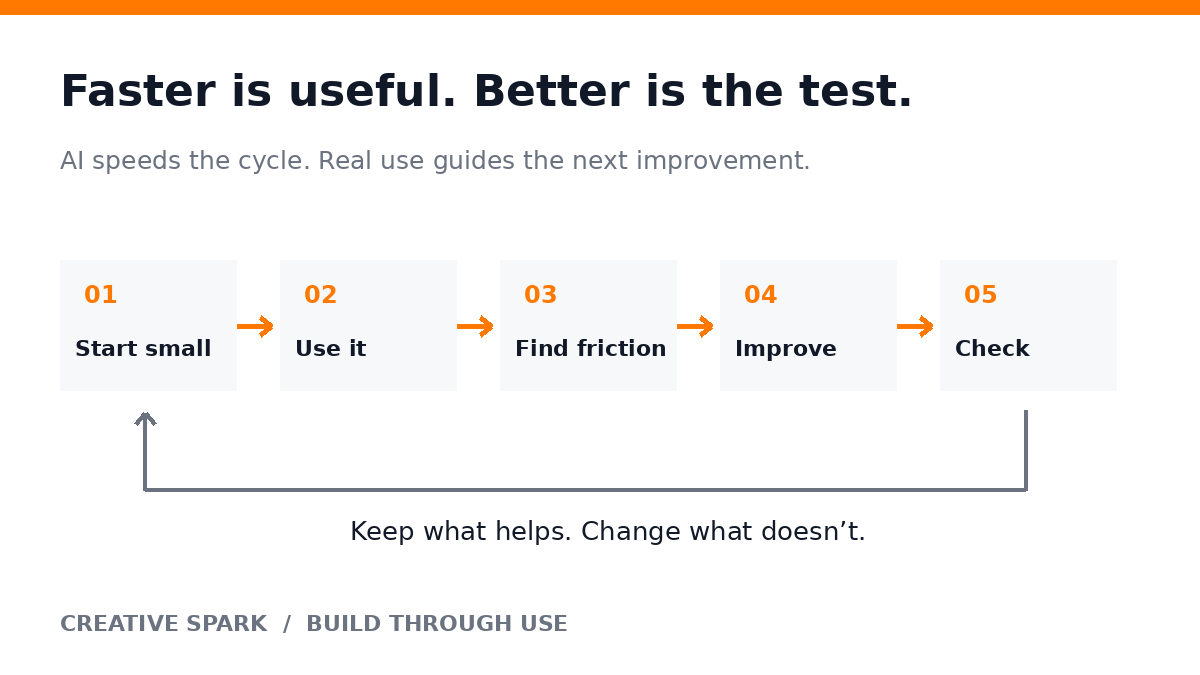
AI makes the cycle faster. It doesn’t decide whether it’s better.
People call some of this “vibe coding.” I tend to call my approach AI-assisted evolutionary development.
In everyday language: I build through use.
I work with AI to turn an idea into something usable, check what it does, learn from it, and keep improving it.
AI can speed up the iterations. Real use tells me whether they’re improvements.
Those are different jobs.
A feature that runs once isn’t automatically dependable. Automated checks, code review, and human judgment help the work become solid as it grows. The checks need to match what the tool is supposed to do, including what should happen when something goes wrong.
Faster building is useful when it helps us reach a better result. It’s not the result by itself.
A small improvement needs a clear finish
Evolution doesn’t mean an endless project with no commitments.
When there’s a deadline, the version needs a boundary: this particular workflow will work, and here’s how we’ll demonstrate it.
For a small business trying this approach, I’d start with one task:
- Describe how it gets done today.
- Pick one part that creates unnecessary effort.
- Build a small improvement with clear limits.
- Use it with a realistic example and check the result.
- Decide what to keep, change, or stop.
You don’t have to rebuild the whole business to learn whether one improvement helps.
Four words, still useful
I remember a phrase from an old meeting. What matters to me now is how it shows up in the work.
Reduce friction. Evolve through use. Build with AI and validate the work.
That’s the approach I’m bringing to NoodleNet and Creative Spark.
If you’re looking at AI for your business, start with the thing that keeps getting in your way. Give the first improvement a clear job. Let actual use show you what should come next.
And Erik—thank you. Those four words stuck.