

A demonstration answers, “Could this work?” A pilot should also answer, “When do we stop?”
That second question is easy to postpone when an AI-assisted tool produces something useful on its first attempt. For an MSP, postponing it can turn a small experiment into an unplanned support commitment.
The client sees a helpful screen. Your team inherits a new place where something can break. Those are both part of the same project.
Choose a pilot you can put down
Imagine a fictional MSP experimenting with an internal handoff checklist. It uses example tickets, not customer records. The first goal is to see whether the checklist captures the information the next technician needs.
AI-generated editorial illustration—not product hardware or a screenshot.
Before building, the service lead names a few reasons to stop: the helper misses an important handoff detail, staff cannot explain its output, or keeping it accurate creates more work than the experiment justifies.
That isn't pessimism. It makes “let's try it” a real experiment rather than an accidental promise to operate something forever.
Pick an owner and an end-of-pilot decision. Continue, revise or stop should all be legitimate answers.
Count the work the demo leaves out
AI can produce a useful draft and still invent a step, misunderstand a technical note or make a recommendation sound more certain than its source supports.

AI-generated editorial illustration—not product hardware or a screenshot.
Someone needs to compare the result with the original example. Someone needs to maintain the instructions when the service process changes. Someone needs to know what to do when the helper is unavailable.
If nobody owns those jobs, the support team is likely to discover them later. “The AI built it” isn't a maintenance arrangement.
Manual time entries and estimates can help frame an experiment, but fictional sample costs are not measured savings. Decide what you would actually observe before making a business case. Build keeps cost and time with each project: original minutes are manual, billing rounding is a separate setting, and prices can remain unknown rather than being treated as zero.
Keep the operating boundary visible
The documented Noodle Build workflow separates saved source, preview behavior and a reviewed local runtime. That distinction can help an MSP avoid treating an attractive prototype as a finished service.
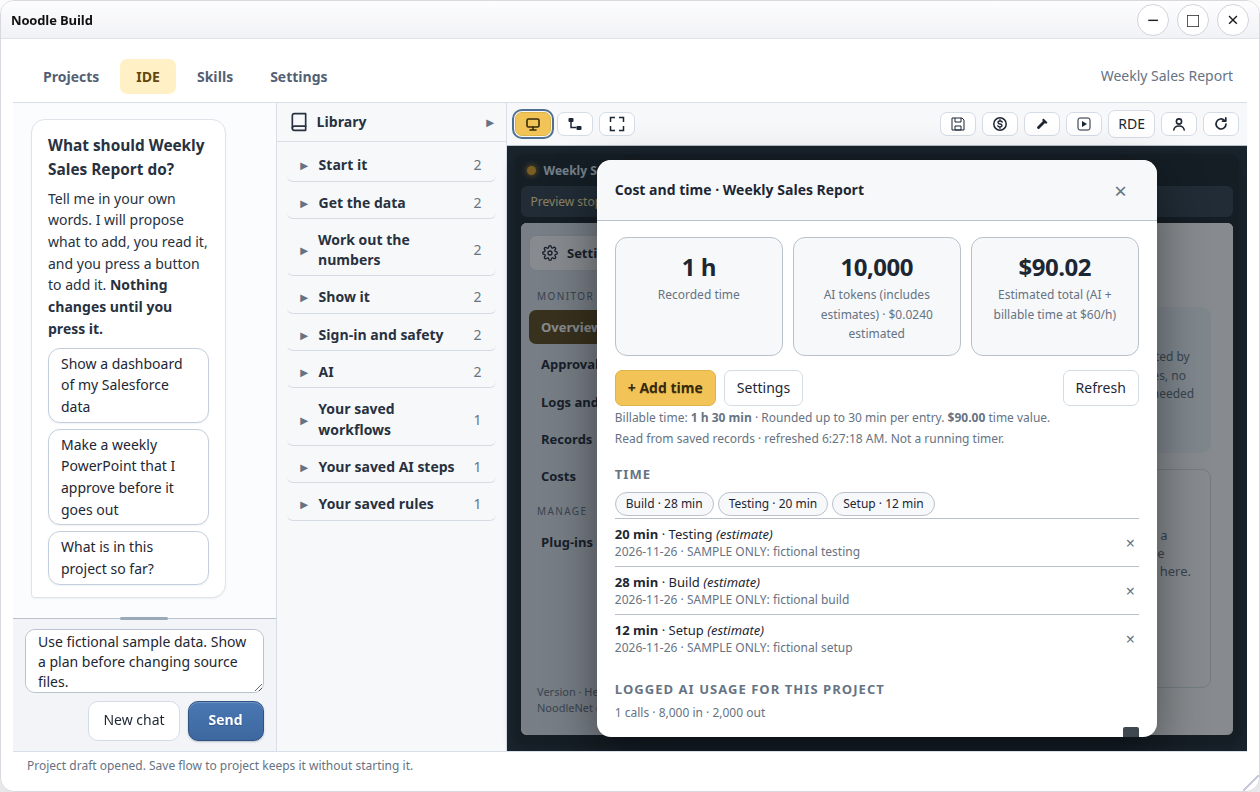
All figures here are fictional. Time is manually recorded; Refresh is not a stopwatch or a provider bill, and these are not measured savings. Controlled test session; fictional examples.
A source archive can support inspection and handoff. A reviewed local plan can make intended behavior clearer. A project-specific Stop control is relevant to a local trial. None of those, by itself, proves delivery to a client site or reliable unattended operation.
Noodle Build is now the official development workspace. Its migrated projects preserve source and records; opening source does not start an app or convert it automatically into a compatible runtime. The remote-delivery path remains unfinished. Don't fill that gap with an optimistic arrow on a slide.
Agree the exit before the pilot starts
Write down who can stop the experiment, what they will check afterward and which existing process staff will use instead. Keep the original workflow available while testing the alternative.
For the internal checklist example, an exit might simply mean returning to the existing handoff form, retaining the source and recording why the pilot did not continue. That is learning, not a failed sales story to hide.
The useful outcome is a clearer decision about the work—not a larger pile of tools that now need looking after.
If the pilot raises questions about who approves a change, the NoodleNet article on keeping the decision human-owned explains that boundary in more detail.
Curious where AI could help your clients, but wary of inheriting a tool nobody can explain or support? Let's grab a coffee and explore the options.