
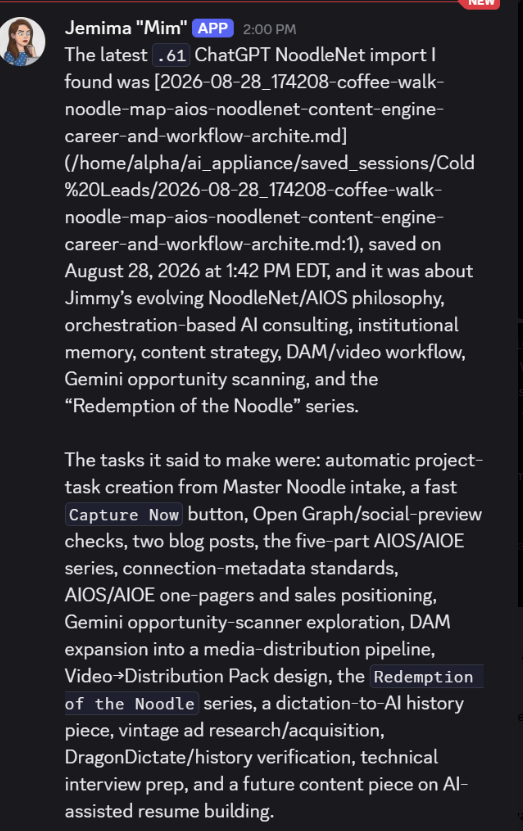
My lunchtime LCW produced 22 ideas, somewhere around 17 actual themes, and what appears to be enough follow-up work to justify hiring a small administrative staff.
LCW stands for Long Coffee Walk, because I like labeling everything. Apparently, once you reach a certain age, wandering around with coffee and talking to yourself needs branding.
What struck me today, though, was how completely backwards the relationship with software has become.
A few years ago, work software came with an expectation: you adapted to it. You learned the menus, memorized the workflow, figured out which tab Steve from accounting swore you absolutely had to click first, and eventually became "proficient" enough that you stopped openly threatening the computer.
The software had a way it wanted things done. Your job was to learn that way.
Now I go for a walk and talk.
That's basically the interface.
I talk to my agent in plain English, using voice, bouncing back and forth the same way I would with another person. I ramble about NoodleNet, AIOS, content ideas, video workflows, consulting, Gemini, something I should write, something I forgot to do yesterday, and probably three subjects that seemed brilliant for about fourteen seconds.
The system adapts to that mess.
What changed
Today's conversation produced 22 tagged subjects and roughly 17 major themes once the overlapping ideas were collapsed together. More importantly, those thoughts did not just disappear into the traditional middle-aged-man idea-management system of "I'll definitely remember that later."
They were stored.
They were connected to things I am already working on.
They were aligned with existing projects and ideas.
The system spotted action items buried inside the conversation, even when I had not specifically announced, "ATTENTION COMPUTER, THIS NEXT SENTENCE IS A TASK."
That part matters.
We talk a lot about AI taking notes, summarizing meetings, or helping us remember things. That is useful, but I think the bigger shift is what happens next.
The real shift is action
The system can act.
It can recognize that an idea belongs in a project, create the task, start the research, prepare content, or hand work to another agent. What used to end with me writing something on a Post-it note now has the potential to become an actual workflow.
For someone whose brain has historically treated good ideas like fireworks, bright, exciting, and completely gone five seconds later, this is not a small upgrade.
And this is really what fascinates me about AIOS and AIOES.
For decades we adapted ourselves to software. We learned how the machine wanted us to work.
Now we are beginning to build software that learns how we work.
It listens to the way we naturally communicate. It understands our projects, our patterns, our context, and increasingly our intent. Instead of forcing us into somebody else's workflow, the environment starts forming around us.
That feels like a much bigger change than another chatbot or productivity app.
It feels like software finally getting out of the way.
Why this matters
This post is one of the receipts.
During my walk, I mentioned that this whole idea was probably worth writing about. The system caught it, recognized it as an action item, and preserved it along with everything else.
So here we are.
My software reminded me to write a post about how my software no longer requires me to remember everything.
It's a wonderful world.