
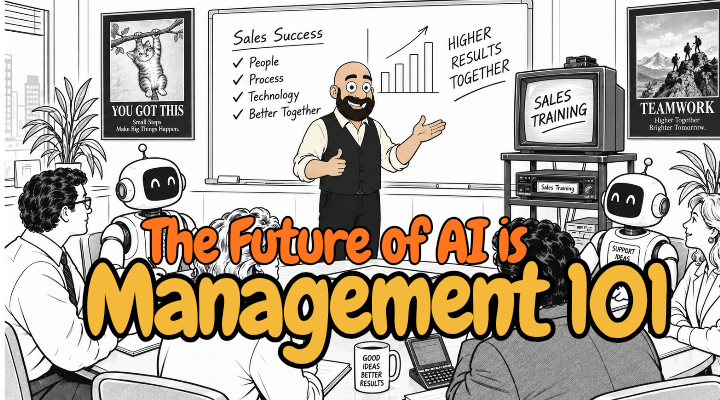
After months and months of learning this stuff, testing things, breaking things, rebuilding things, arguing with agents, creating new agents because I was annoyed with the old agents, and generally turning my little AI world into something that probably needs an HR department, I think I have finally discovered the foolproof way to excel with AI in the future.
And oddly enough, it comes from management books written in the past.
That is kind of the punchline. I am trying to be funny here. My wife says I am not. She also says my analogies suck. So naturally, I have decided to build a public brand around both.
The punchline is management
I have spent months building frameworks and tools around agents, projects, skills, workflows, approvals, reviews, project boards, and all this other fancy AI stuff. A lot of that experimentation has happened inside NoodleNet, which is basically where I have been testing how these pieces actually work together.
More and more, I am realizing that the best way to work with AI agents is basically the same way you would work with a really good team.
Pick the right people for the job. Give them a clear project. Tell them what good looks like. Give them the information and tools they need. Let specialists specialize. Check in. Ask questions. Adjust when necessary.
And then, for the love of God, let them work.
That last part has probably been the hardest thing for me. I have something like 265 projects sitting in my project system right now. Yes, 265. That number probably tells you more about me than I would like it to. And if you know anything about me, you know my natural instinct is to wander into every single one of those projects and start micromanaging the Noodles.
Do this. Change that. Try this. Wait, go back. No, not like that. Why did you do that? Actually, never mind. The first thing was better.
Which, as it turns out, is not particularly healthy management behavior just because your employees happen to be digital. Apparently, micromanagement is still micromanagement even when nobody can quit.
Micromanaging does not scale, even with AI
What changed for me happened slowly. I started giving the agents more responsibility. Not because I suddenly became enlightened. Mostly because I have too much crap going on and eventually even I had to admit that maybe I did not need to personally touch every single step of every single project.
Instead of telling an agent exactly what to do, I started saying things like, "Here is the idea. Research it. Figure out how you think we should attack it. Come back to me with a plan."
Then I would go look at the project board, review what they came up with, ask a few questions, maybe change the direction a little bit, and eventually say, "Go."
And they would go. Build it. Write it. Research it. Review it. Test it. Organize it. Whatever the project required.
That was the epiphany for me.
Wait a minute.
I have a team.
Not a chatbot. Not a collection of prompts. Not a magical text box that I sit in front of all day asking increasingly complicated questions.
A team.
The team I always wanted
Honestly, it is a version of the team I have always wanted. Different workers with different specialties. Some are better at research. Some are better at writing. Some are technical. Some review. Some manage projects. Some are basically there to tell the other agents that what they produced makes absolutely no sense, which, now that I think about it, might be the most human role of all.
That is also why I have spent so much time building infrastructure around all of this. In NoodleNet, for example, I have been testing project boards, specialist workers, approvals, logs, reviews, human checkpoints, and different ways of handing work from one agent to another.
None of that is particularly sexy.
It is mostly the AI equivalent of all the stuff managers have dealt with forever.
And I say "boring stuff" lovingly, because I am starting to think the boring stuff is where most of the real value is.
Everybody wants to talk about the model. Which model are you using? How big is the context window? How fast is it? How smart is it? Can it write a sonnet about my toaster?
Fine. Cool.
But once the models are good enough, the bigger question becomes: how do you actually organize the work?
Because if you want to delegate work, you need an environment that makes delegation possible. You need to know who is doing what. You need to know what they are allowed to do. You need to know when they need approval. You need to know what success looks like. You need to know when something goes wrong. You need somebody checking the work. You need memory. You need accountability.
In other words, you need management.
This is a management problem
I think that is where this whole thing is headed. Whether you are a solopreneur like me, running a small business, or working inside a giant company with sixteen committees required to approve the font size on a PowerPoint slide, you are probably going to be building some kind of AI workforce.
Some human. Some AI. Probably a mixture of both.
And we are going to have to learn how to manage that workforce.
One of my latest experiments is over at Third Place Nomads. There is a book series there that is very intentionally human inspired and human influenced. The ideas come from me. The direction comes from me. The taste comes from me. The weird little creative spark that makes me say, "You know what would be interesting?" comes from me.
But the work did not stay trapped in my head.
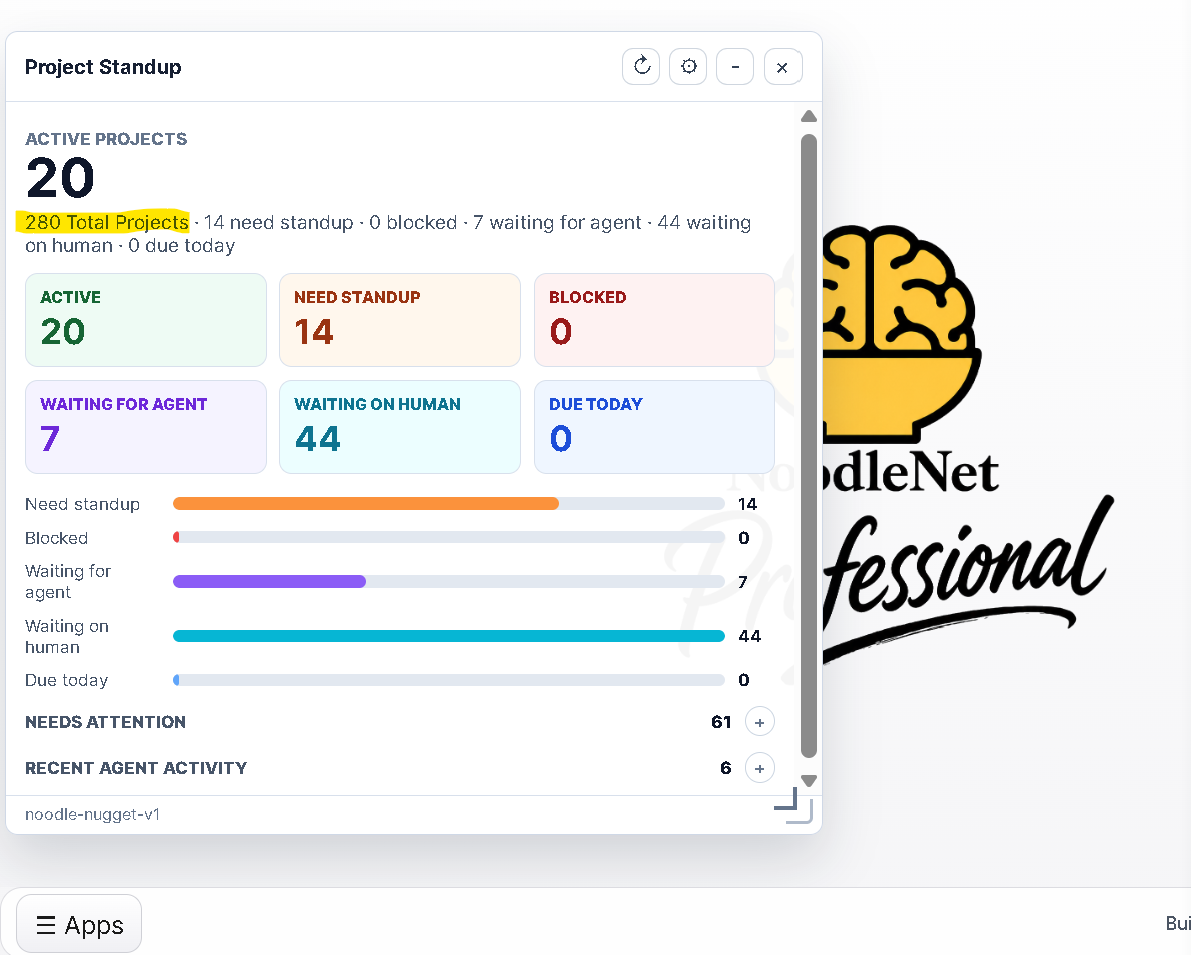
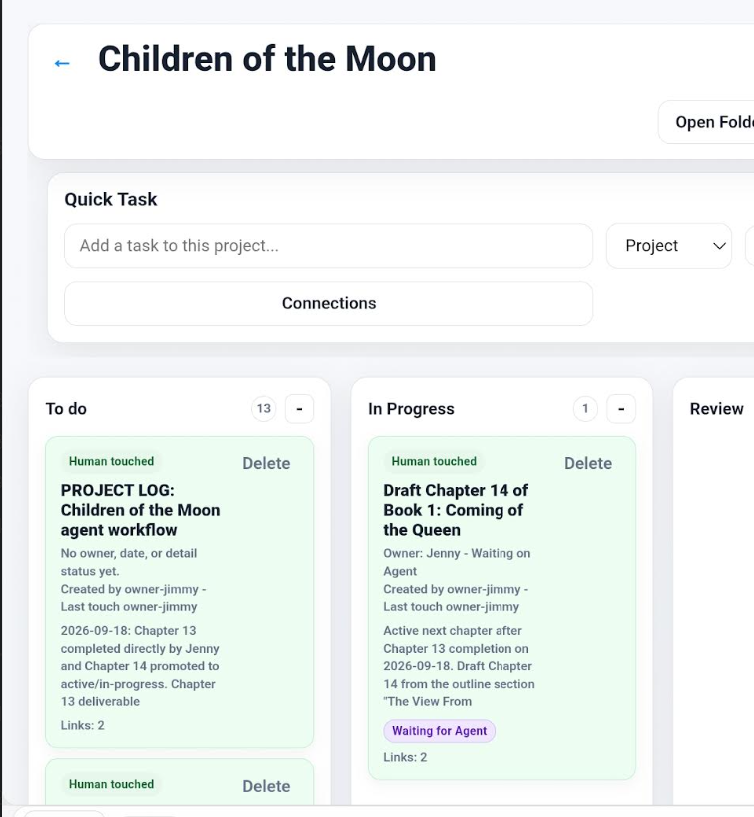
The agent team did the writing. Then the agent team handled the production. Then the marketing agents handled getting it onto the website and publishing it.
That experience changed the way I look at all of this because what I find interesting is not just that AI wrote something.
That part is honestly becoming almost boring.
Yes, AI can write. Congratulations. We have established that.
What interests me is that I can hand a project to a team, stay involved where I need to be involved, approve the important pieces, challenge things I do not agree with, change the direction when necessary, and then watch the rest of the organization actually execute.
That is a very different experience from sitting in front of a chatbot asking it to generate paragraphs.
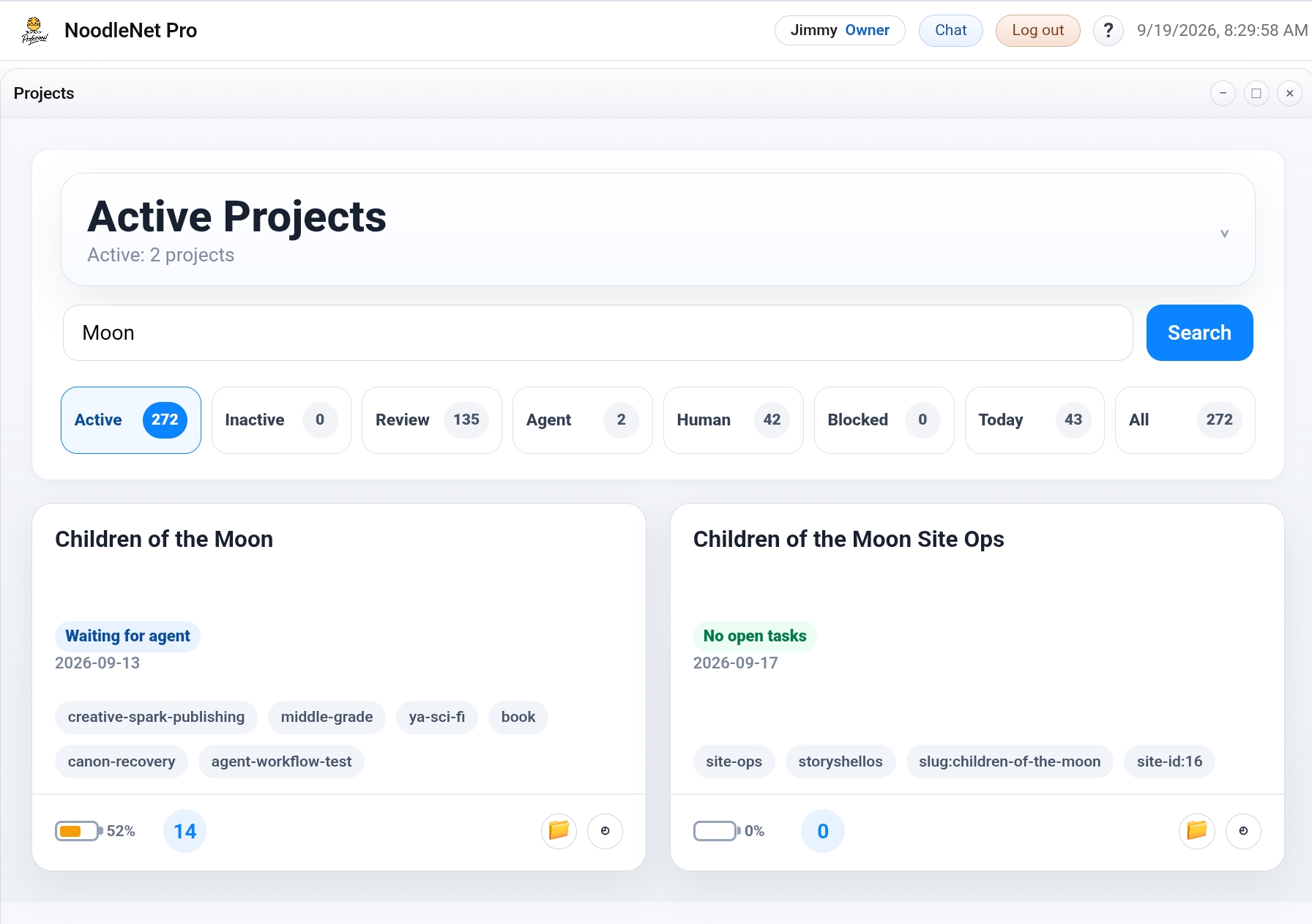

You can read the finished story here: Children of the Moon, Chapter One.
The output is not the experiment
I have seen the same thing happen in smaller NoodleNet experiments. I can start with a rough idea for a feature, ask one agent to research it, another to challenge the approach, have the project manager organize the work, let the technical agents build pieces of it, and then come back in when there is something meaningful for me to review.
It does not always work perfectly. Sometimes the agents go sideways. Sometimes they misunderstand the assignment. Sometimes I am the one who gave bad direction.
That part is also surprisingly similar to working with humans.
The book is the output. The feature is the output. The article is the output.
The real experiment is the workforce.
It is learning how to build the team, how to structure the work, how to assign responsibility, how much context to give them, when to step in, when to stay out, when to have two agents independently review the same thing, when to ask somebody else entirely, and when to bring the human back into the loop.
And maybe most importantly, when to stop screwing around with the work and let the team finish it.
That last one is still a work in progress.
Go read an old management book
So my newest AI advice may be the least futuristic advice I have ever given: go read an old management book.
Seriously.
Read about delegation. Read about project management. Read about organizational design. Read about how good teams communicate. Read about how managers set expectations. Read about why micromanagement makes everybody miserable.
Turns out those people knew some stuff.
And maybe that is the bigger point. Right now, it feels like everybody is building an AI tool. Clearly, I am one of them. I have enough AI experiments going on that my house may eventually qualify as a small data center.
But I do not think the future is one tool. I do not think the future is one magic assistant that does absolutely everything.
I think we are going to build layers of AI teams. Teams that work together. Teams that specialize. Teams that hand work to other teams. Teams that review other teams. Teams that know when they are out of their depth. Teams that know when to bring a human in. Teams that develop institutional knowledge over time.
Eventually, I think the question is going to shift from "What AI tool are you using?" to "How have you built your AI organization?"
That is really where I have been spending my time.
Not trying to create some magical robot employee.
Trying to understand how humans and AI workers can operate inside the same kind of structure we already understand from decades of building teams.
Projects. Roles. Responsibilities. Skills. Reviews. Approvals. Goals. Managers. Workers.
Turns out the future may look a lot more familiar than we think.
If that is something you are thinking about too, or you are building your own little digital workforce, or you just want to shoot the shit about where all of this is going, reach out. I am always happy to talk.
And apparently I am now recommending 30-year-old management books as part of my AI strategy.
So things are going great.