
Most project management tools are built around one question:
What needs to be done next?
That is useful, but it is only a small part of how real work happens.
Projects rarely begin as perfectly organized tasks on a board. They begin as ideas. Notes scribbled during coffee. Files we save because they might matter later. Conversations that change our direction. Links we promise ourselves we will revisit. Half-formed thoughts that may become something important, or may quietly disappear.
Some projects have long lives. Some only last a few days. Some never become projects at all.
But even the ideas that do not survive may contain something valuable.
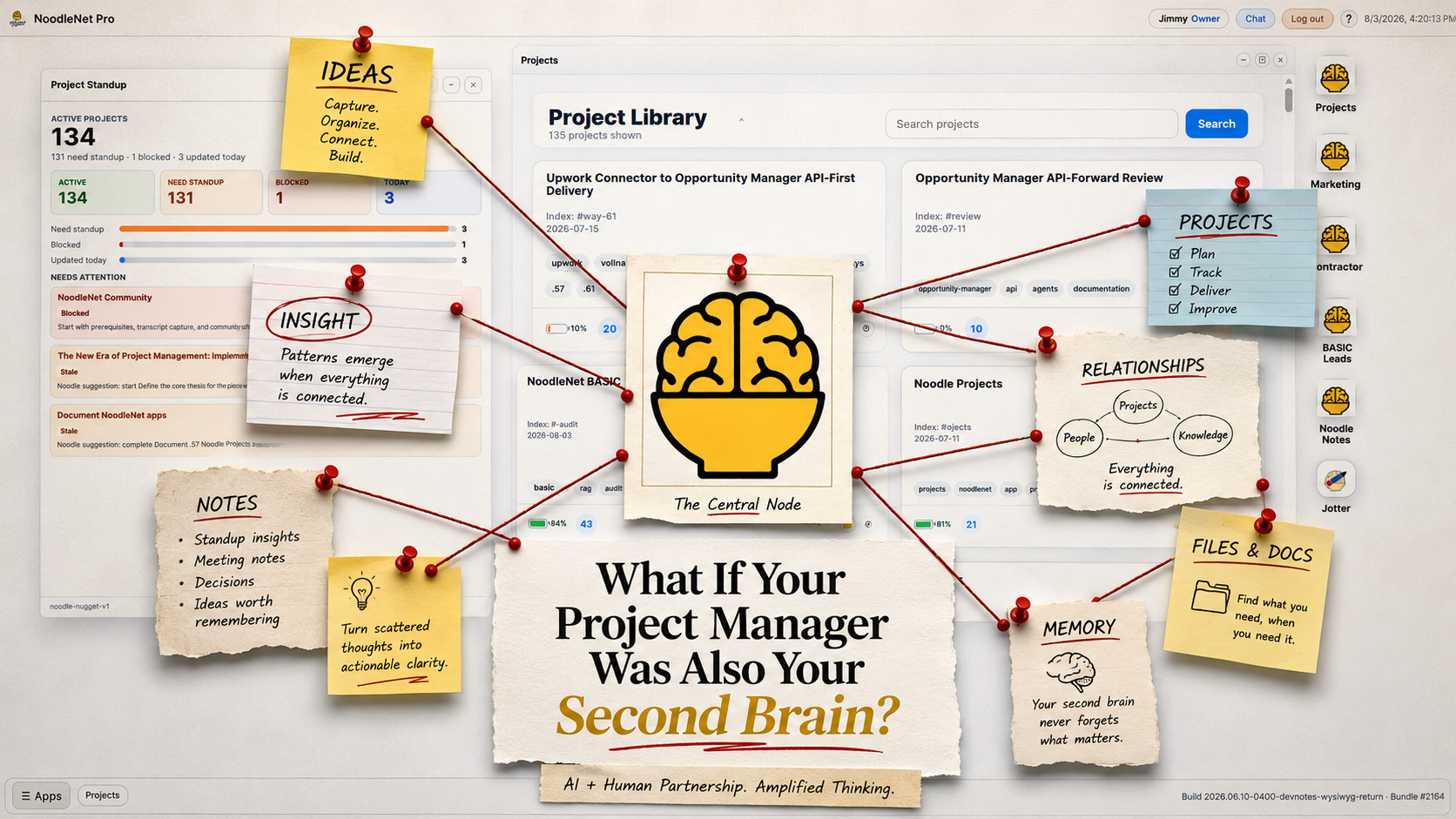
So what would happen if we stopped thinking about a project manager as a place where we organize tasks and started thinking about it as part of our second brain?
You could pour your ideas into it before they were fully formed. You could add notes, files, questions, meeting summaries, research, decisions, and all the random "it would be cool if..." thoughts that appear throughout the day.
Then your AI agent buddies could help you see through the noise.
They could remind you why you started a project in the first place. They could find a note you wrote six months ago that suddenly matters again. They could recognize that two separate projects are really parts of the same larger idea.
They might tell you that you already researched the problem you are trying to solve. They might surface a conversation containing an answer you had forgotten. They might notice a connection between a customer question, a saved article, and an unfinished project that you never would have connected on your own.
That is where the relationship between humans and AI becomes interesting.
AI does not need to replace the person doing the work.
It can amplify them.

You still decide what matters. You still provide the imagination, judgment, curiosity, empathy, and lived experience.
AI helps you hold onto more of your thinking, find patterns across it, and bring the right knowledge forward when you need it.
It allows you to spend less energy trying to remember where something is and more energy deciding what to do with it.
A traditional project management system knows the tasks you entered into it.
A second-brain project manager begins to understand the story behind the work.
It knows the ideas that led to the project. It remembers the decisions that changed it. It can see what the project connects to, what you have already learned, and what might be useful next.
And what if it also had access to your notes, documents, saved links, meeting summaries, previous projects, and conversations?
Now it is no longer looking at your work through a collection of disconnected apps.
It can begin seeing the larger Noodle.
Not just the task.
Not just the note.
Not just the file.
The connections between them.
That is the power of AI.
The app is not the most valuable part anymore.
The real power is the Noodle.
It is the memory. The context. The relationships between ideas. The ability to uncover something you forgot, recognize something you never noticed, and connect your past thinking to the work sitting in front of you today.
The app is simply where the relationship happens.
The human provides the purpose.
AI provides memory, connection, and leverage.
Together, they can give people the cape so they can become the superheroes they always knew they were.
But the more useful this relationship becomes, the more personal and valuable the knowledge behind it becomes.
So as we begin building these deeply personal working relationships with AI, there is one question I would ask every solopreneur:
Where do you want all of that data to exist?