
Everybody wants to talk about AI agents.
Fair enough. They are interesting.
The idea of having digital workers that can research, draft, review, organize, and move work forward sounds a lot better than opening seven tabs and pretending that copy-and-paste is a business process.
But most businesses do not fail with AI because they picked the wrong agent name.
They fail because the work underneath the agent is still messy.
The prompts are scattered.
The documents are scattered.
The workflow lives in someone's head.
The approval process is mostly vibes.
The tool stack looks like it was assembled during a thunderstorm.
Then someone drops an AI agent on top and expects the whole thing to become a system.
That is not an AI strategy. That is putting a tiny robot hat on an existing operations problem.
Start with the work
The useful question is not, "Which AI tool should we buy?"
The useful question is, "How does this work actually move through the business?"
Who owns it?
What information do they need?
What decisions require a human?
What steps are repeated every time?
Where does the work get stuck?
What should be documented before anyone automates anything?
That is where AI starts becoming useful. Not magical. Useful.
Digital workers need jobs, not gimmicks
If a business is going to use digital workers, those workers need a place in the operation.
A marketing worker might prepare campaign drafts.
A sales worker might summarize discovery notes.
An operations worker might inspect delayed projects.
A finance worker might check invoices against approved terms.
That is different from creating a generic chatbot and asking it to "help with business stuff."
The worker should answer one plain question:
Who owns this work?
If nobody can answer that, the agent is probably just another digital junk drawer with a friendly name.
Skills are where the value starts to repeat
One prompt is useful once.
A reusable skill is useful again and again.
That is the difference between an employee keeping one decent ChatGPT prompt in a private chat and the business having an approved way to handle a recurring task.
Skills might include:
- turning a call transcript into a follow-up email;
- checking a proposal for missing details;
- turning a long article into social posts;
- summarizing a project handoff;
- comparing a request against an internal policy.
This is not about replacing judgment.
It is about reducing the amount of repetitive setup needed before judgment can happen.
Plays make AI part of the workflow
A play is the process.
It defines when something starts, what steps happen, who or what handles each step, what needs approval, and what gets recorded.
This matters because most AI use today is still trapped in individual chat sessions.
Someone does something useful once.
Everyone agrees it was helpful.
Then nobody turns it into a repeatable process.
Three weeks later, the same work happens again from scratch because apparently we enjoy suffering.
Plays prevent that.
They turn useful AI moments into business routines.
Connectors are access, not operations
Connecting AI to Gmail, Drive, a CRM, WordPress, or a project system is important.
But access is not the same thing as a working process.
A connector answers:
Can this system talk to that tool?
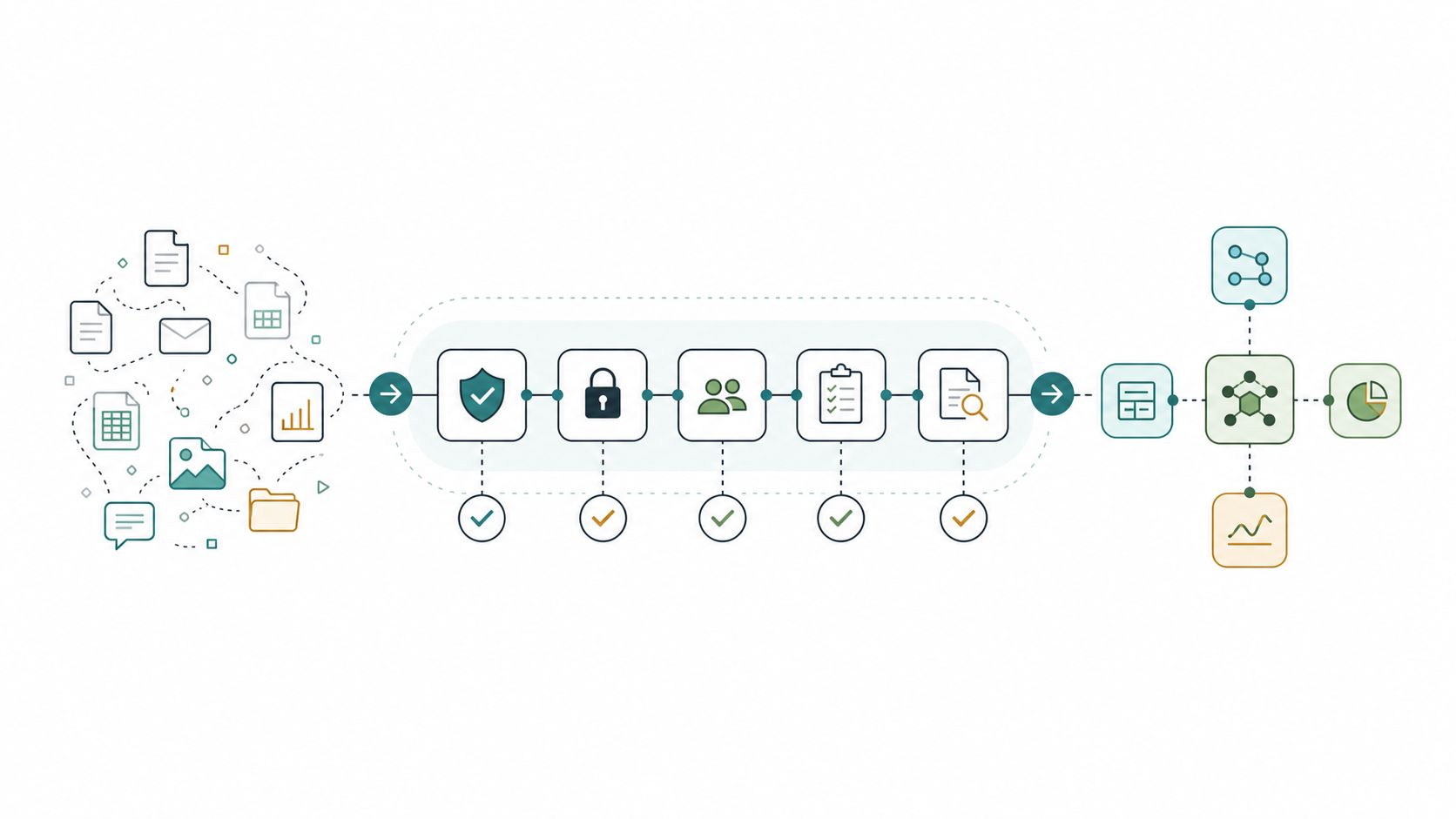
The operating layer has to answer harder questions:
- Is this action allowed?
- Is the information complete?
- Does a human need to approve it?
- Did the update actually succeed?
- Can it retry without creating a mess?
- Where is the record of what happened?
This is the gap between a demo and a dependable business workflow.
Knowledge matters more than novelty
AI workers need the right context.
Not every file. Not every folder. Not every random note from 2019.
The right context.
Approved documents. Current procedures. Useful examples. Client rules. Brand guidance. Prior decisions. Things the team actually trusts.
Without that, the system is just guessing with confidence, which is already a popular enough business model.
Humans still run the business
The point is not to remove people.
The point is to stop making people act as the glue between every tool, prompt, document, approval, and follow-up.
The human should set direction, define boundaries, approve sensitive actions, handle exceptions, and make the calls that require judgment.
The human should not have to manually carry every task between five apps like a tired office courier.
That is not human-in-the-loop.
That is human-as-the-loop.
The practical path
Before buying another AI tool, map the work.
Find the repeated tasks.
Inventory the prompts.
Identify the knowledge sources.
Decide what can be automated, what needs approval, and what should stay human-led.
Then build from there.
The best AI system is not the one with the most agents.
It is the one where the work is clear, repeatable, observable, and useful.
Not as shiny on a webinar slide, maybe.
But much better for running an actual business.