
A lot of smaller businesses are curious about AI, but they do not want to begin with a sprawling software stack, a consulting-heavy rollout, or a pile of vague promises. They want a practical starting point that respects how small teams actually work.
That is the point of NoodleNet Basic.
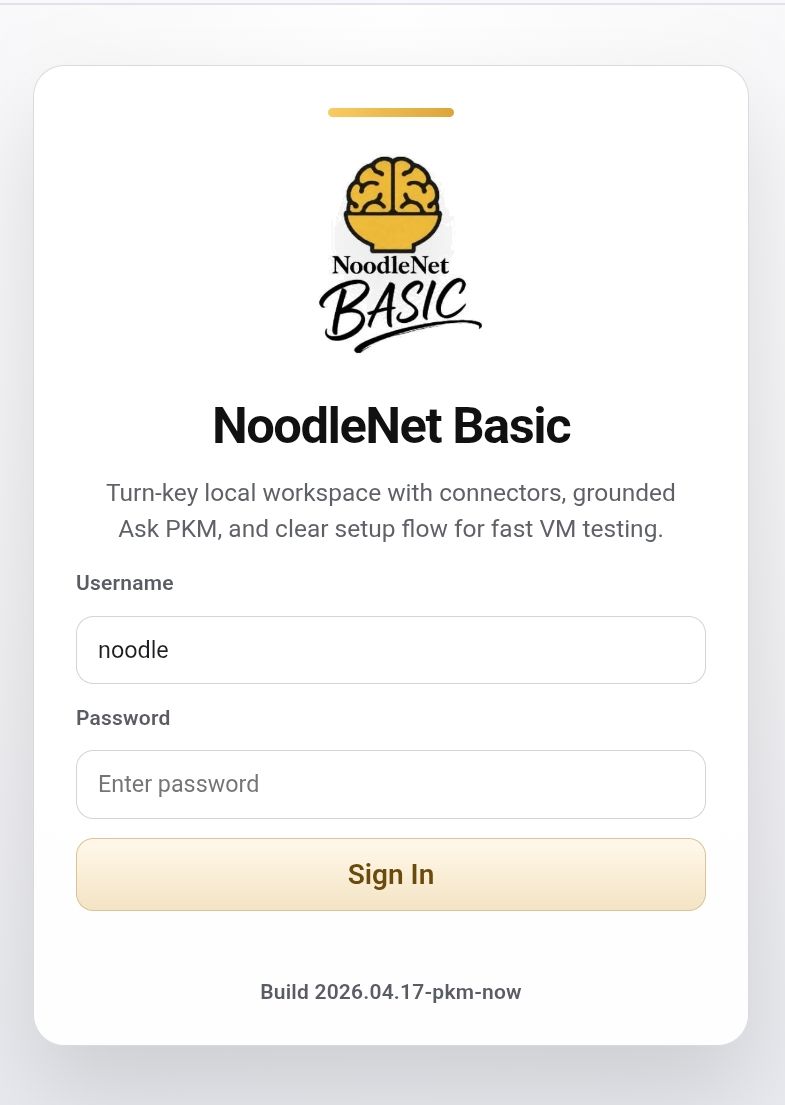
NoodleNet Basic is the soon-to-be-released free edition of the NoodleNet appliance. It is designed as a full local workspace that can be deployed as a virtual machine, giving solopreneurs and small to midsize businesses a realistic way to evaluate AI in an environment they can actually understand and control.
This is not just a demo or a stripped-down teaser. The value of NoodleNet Basic is that it gives organizations a grounded, business-friendly place to begin. Teams can test real workflows, connect useful tools, and see where local AI can support operations before they commit to a bigger long-term rollout.
Why the appliance model matters
For many smaller organizations, the real blocker is not lack of interest. It is governance, clarity, and trust.
When AI gets introduced through disconnected browser tabs and personal experiments, business leaders immediately run into reasonable questions:
- Where is company information going?
- Who can access what?
- Which workflows are approved?
- How do we separate useful experimentation from operational risk?
A local appliance changes that conversation.
By packaging the workspace into a deployable VM, NoodleNet Basic gives businesses a more disciplined starting point. Instead of scattering activity across random tools, the team gets a defined environment for testing, operating, and learning. That matters because governance is not just an enterprise concern. Even a five-person company needs clear boundaries around client information, internal knowledge, repeatable process, and decision-making.
In plain English, governance at the business level means:
- having a known place where AI work happens
- keeping useful information organized and recoverable
- making it easier to decide what should be standardized versus what should stay experimental
- reducing the chance that important work gets trapped in one person’s personal tool chain
That is the kind of structure small teams usually need before AI becomes sustainable.
Built for the way solopreneurs and SMBs actually operate
NoodleNet Basic is aimed at the operator who wears multiple hats and the small team that cannot afford chaos. That includes solo founders, owner-operators, and SMB teams trying to improve how they work without taking on a giant transformation project.
The appeal is practical:
- a full appliance instead of a loose collection of apps
- deployable as a VM for straightforward testing
- local-first operating posture
- room to establish governance early
- immediate exposure to workflows that can produce measurable business value
For this audience, “free” only matters if the system is also useful. The point is not novelty. The point is faster learning, lower friction, and a safer path to identifying what actually deserves investment.
Two ROI apps worth paying attention to
NoodleNet Basic becomes easier to understand when you look at the first two business-facing applications inside it.
1. AskPKM, an indexed RAG knowledge base
AskPKM is the grounded knowledge layer.
At a practical level, it is an indexed retrieval system that helps a business work with its own documents, notes, and reference material more intelligently. Rather than relying on generic prompting alone, AskPKM is meant to improve answers by drawing from curated source material that the business already values.
That matters because one of the earliest AI disappointments for small teams is vague output. A retrieval-backed knowledge system improves the odds that the assistant is responding from the right body of information instead of improvising from thin air.
The business value is straightforward:
- faster access to internal knowledge
- less re-searching across folders, notes, and scattered references
- better continuity when only one person remembers where something lives
- more confidence when using AI for answers tied to company material
For a solo operator, that can mean less time spent re-finding what you already know.
For a small team, it can mean fewer knowledge bottlenecks and a more consistent way to support day-to-day decision-making.
2. Opportunity Manager
Opportunity Manager is the commercial discipline layer.
Smaller businesses rarely struggle because they have no opportunities. They struggle because follow-up, visibility, prioritization, and next actions drift when everyone is busy.
Opportunity Manager is designed to help keep active revenue conversations visible and operational. Instead of letting sales momentum live in memory, inboxes, or disconnected notes, the goal is to create a clearer working surface for tracking progress and acting on what matters.
The business value here is easy to understand:
- better visibility into open opportunities
- less dropped follow-up
- clearer next steps
- more consistent handling of pipeline activity
That is the kind of app that can create ROI quickly because it sits close to revenue. For a solopreneur or SMB, improving opportunity hygiene is often more valuable than chasing a flashy use case that never connects to actual business outcomes.
Why this matters now
Many small businesses are somewhere between curiosity and caution. They can see that AI is changing expectations, but they do not want to jump straight into a messy operational experiment.
NoodleNet Basic offers a saner bridge.
It gives organizations a way to start with a full appliance, explore local AI in a controlled environment, and focus on use cases that matter to the business. The combination of VM deployment, business-level governance, AskPKM, and Opportunity Manager makes it easier to evaluate AI as an operating system for useful work rather than as a series of disconnected tricks.
That is the right frame for a serious small business. Start with control. Start with practical value. Start with the workflows that can actually teach you something.
NoodleNet Basic is meant to make that first step easier.