A customer says yes. Someone promises a delivery date. The proposal lives in one system, the notes in another, and the work gets entered into a project board when somebody has time.
Now add an AI agent to that picture. It can write a lovely project plan, but which version of the agreement should it trust? Who owns the next step? Has the client approved the scope change? Where should the result go?
Those questions are why I have started looking at project management software differently. The interface still matters. The team has to use it. But in an agentic workplace, the way a project manager connects to the rest of the business matters just as much.
Projects are where promises become work
A project system does more than collect tasks. It holds the working agreement between people: what we are trying to do, who owns it, when it is due, what depends on what, and which decisions still need review.
That makes it a natural coordination point for AI. An agent can research a question, prepare a draft, check a document, or flag a delay. To contribute to a real project, it needs the current assignment and enough context to understand the job. It also needs a safe place to return its work, with a visible record of what changed.
If those handoffs depend on someone copying text between screens, the system will become fragile as soon as the volume grows.
What API-forward actually means
An API is the agreed way one system asks another for information or requests an action. An API-forward project manager makes its important work accessible through documented, dependable interfaces. It lets authorized tools read a project, create or update a task, find the right owner, and respond when something changes.
The words authorized and dependable do a lot of work there. The point is not to give every agent a master key. It is to give each worker the access its job requires, keep human approval where the stakes call for it, and leave a trail that can be checked later.
I look for a few practical capabilities:
- Useful coverage. Can the API read and update the projects, tasks, custom fields, time records, comments, and documents the workflow actually uses?
- Change signals. Can the system send a webhook when work changes, or must another tool keep asking whether anything happened?
- Permission boundaries. Can an integration use scoped access, with a clear owner and a way to revoke it?
- Operational headroom. Can it page through a large project, handle rate limits, and recover when a request fails?
- A way out. Can you export the work and its relationships if the business changes tools later?
An “API available” checkbox does not answer those questions. In current products, daily call limits, operations a particular API cannot write, and plan restrictions on webhooks can all change whether a proposed workflow is practical. Those details belong in the selection process, before the team builds around an assumption.
A connected handoff in practice
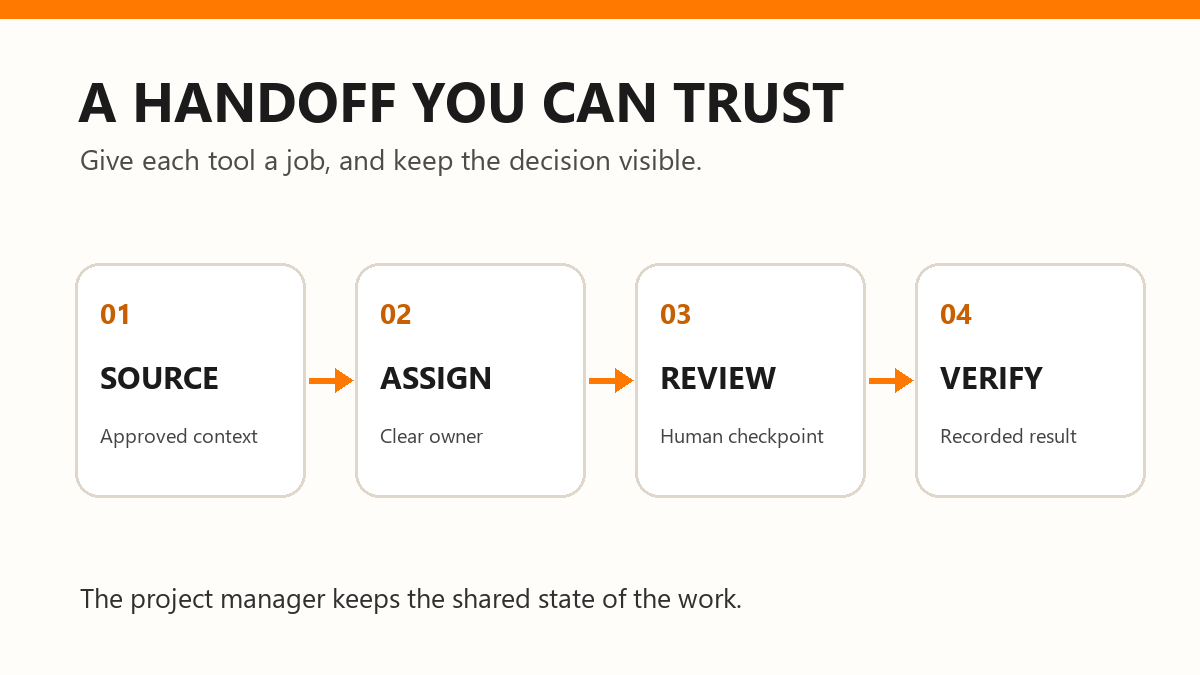
Imagine a service team wins a new engagement. The customer record creates a project with the approved scope and a named owner. The project system assigns the first tasks. A document tool attaches the latest brief. An AI worker reads that brief and prepares a kickoff outline, then adds it to a review task. A person approves or edits it. Only then does the next step move forward.
Each system is doing a job it understands. The project manager keeps the shared state of the work. The document system holds the source material. The AI worker helps with a bounded task. The person remains accountable for the decision.
The value is not that everything happens automatically. The value is that the handoffs are clear enough to automate where appropriate and inspect when necessary.
Choose the workflow before the logo
The first question I ask is not, “Which project manager has AI?” It is, “What work needs to move between your tools, and who should be allowed to move it?”
Start with one real handoff. Draw the path from the original request to the finished result. Mark the systems involved, the owner at each step, the approval point, and the information an agent would need. Then test whether the candidate project manager's API supports that path end to end.
That is a more useful buying test than a long feature grid. It also protects a business from replacing a perfectly good human process with a collection of disconnected automations.
As agents take on more useful work, project management becomes more important. Someone still has to define the goal, track the state, resolve conflicts, and decide whether the result is good enough. A strong API gives the tools a way to speak to one another while keeping that human structure intact.
If you are considering AI for your team, look at the work you already do: where information gets retyped, where ownership gets fuzzy, and where an approval is easy to miss. Creative Spark's AI, Prompt & Workflow Audit is a place to start that conversation with the actual workflow on the table.
Related reading: What If Your Project Manager Was Also Your Second Brain?