
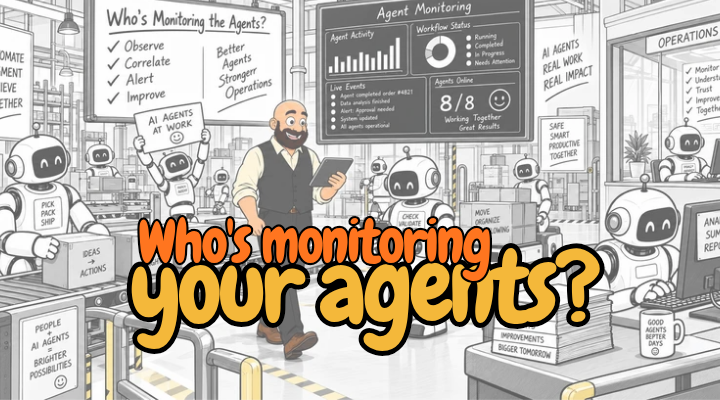
Most small teams do not need a philosophical debate about AI agents.
They need a practical answer to a practical question:
If an AI agent helps with real work, can we see what it did?
That is the everyday version of AI observability. Not a giant enterprise dashboard. Not a vendor whitepaper. Just the ability to understand the work trail.
When an agent touches a project, a document, a CRM record, a support issue, a marketing draft, or a client follow-up, the business should be able to reconstruct the basics later.
What did the agent touch? What tool did it use? What source material did it rely on? Did it make a change? Did it ask for approval? Did a policy stop it? What did the human approve?
Those questions are not bureaucracy. They are how a business keeps AI useful without letting it become mysterious.
The problem with chat-only AI work
Chat is a great starting point. It is fast, flexible, and easy to understand.
But chat history alone is a weak operating record.
It may not show the whole path of the work. It may not connect to the project. It may not preserve the tool call, approval state, source note, or final handoff. It may not make sense to anyone except the person who was there at the time.
That is fine for brainstorming.
It is not enough for business operations.
Once AI agents begin helping with work that affects customers, files, projects, tasks, publishing, or internal systems, teams need something more structured.
They need a work trail.
What a work trail should capture
A useful agent work trail does not have to store every raw prompt and response forever.
In fact, that can create its own privacy and security problem.
The better pattern is structured visibility. Save the information that helps the business understand the flow of work:
- the task or project the agent was working on
- the source material it used
- the tool or system it touched
- the action it attempted
- the result
- whether a policy fired
- whether a human reviewed or approved it
- where the final evidence or artifact lives
That kind of record gives the business accountability without turning every AI interaction into a giant pile of sensitive raw logs.
Human approval is not a weakness
Some AI conversations make it sound like the best system is the one that never asks the human for anything.
That is not how real operations work.
Good systems know when to proceed, when to pause, and when judgment belongs with a person.
An AI agent drafting a post is different from an AI agent publishing it. An agent summarizing a client note is different from an agent sending a client email. An agent preparing an invoice is different from an agent changing the final amount.
The workflow should know the difference.
That is why approval gates, review states, receipts, and audit notes matter. They keep AI assistance inside a business process instead of floating around as an impressive but hard-to-trust side channel.
Where NoodleNet fits
This is the operating problem NoodleNet is built around.
NoodleNet is not just a place to chat with AI. It is an environment for routing AI-assisted work through projects, notes, tools, workers, approvals, and receipts.
The point is not to make agents look magical.
The point is to make their work understandable.
That matters for small teams because the same person is often wearing five hats: owner, operator, marketer, project manager, salesperson, and technical reviewer. If AI is going to help, it cannot add more fog. It has to create leverage and leave a trail.
A simple test
If you are experimenting with AI agents, ask these questions:
- Where does agent work start?
- Where does it get logged?
- What can it touch?
- What can it change?
- What requires human approval?
- Where do receipts and screenshots go?
- Can someone understand the work a week later?
If the answer is "probably, if I remember what happened," the system is not ready yet.
That does not mean you should stop experimenting. It means you should start building the operating layer around the experiments.
Jimmy wrote the companion LinkedIn Article, Who Is Monitoring Your Agents?, for leaders and operators thinking about agent visibility, policy, and accountability at the business layer.
If we are not already connected, connect with Jimmy D on LinkedIn. This is the kind of practical AI operations work Creative Spark and NoodleNet are being built to support.