
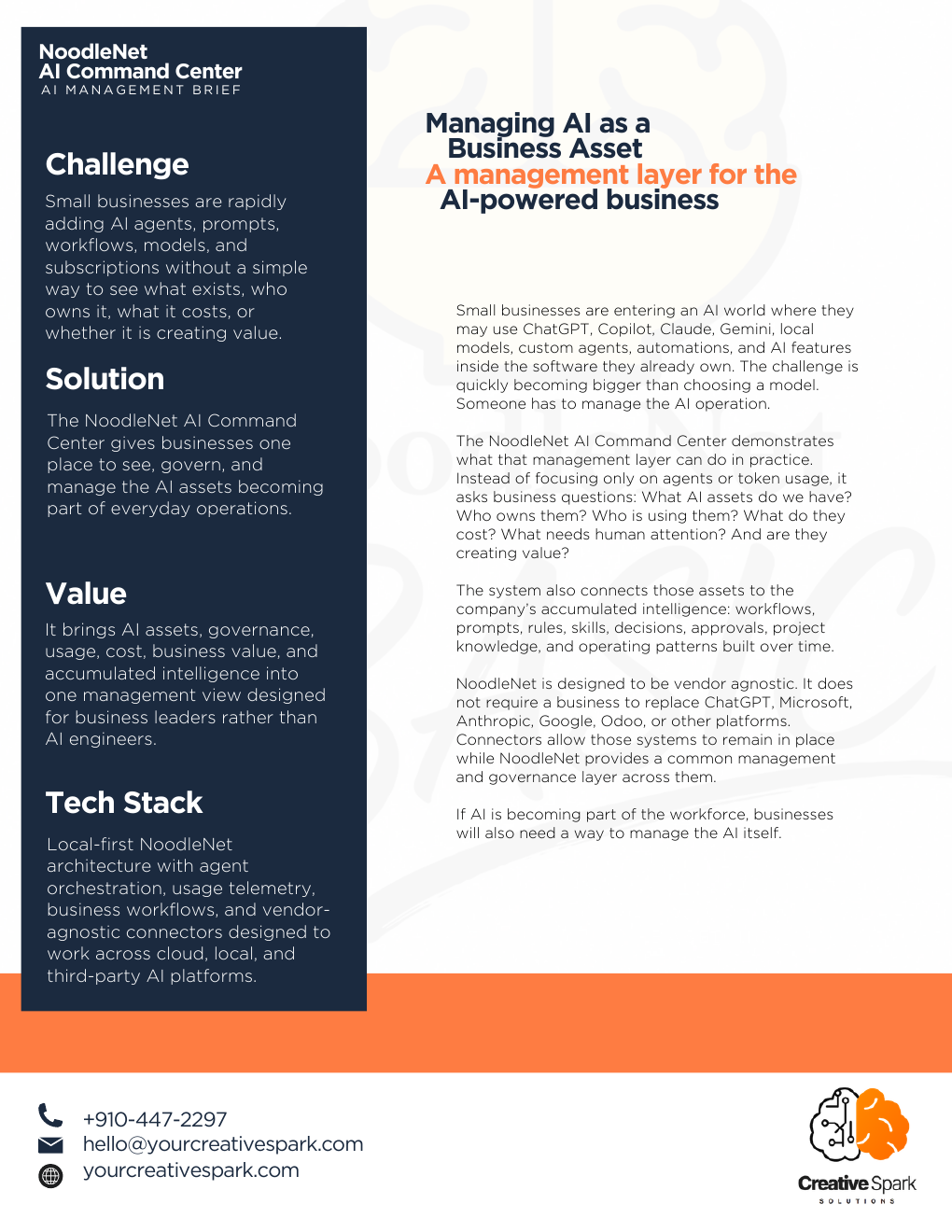
Most small businesses already have an AI operation.
It may not have a budget line with that name. It may not have an owner, a governance plan, or a dashboard. But it exists.
Someone is paying for ChatGPT. Another person is experimenting with Copilot. A team has a useful prompt saved in a private document. A workflow sends data through an AI service. A custom agent was built for one project. A model is running locally on a machine that only one person understands.
Individually, each choice may be reasonable.
Together, they create an operating environment that the business may not be managing at all.
The tool conversation is getting too small
For the last few years, most AI discussions started with a product question:
Which AI tool should we use?
That question still matters, but it is no longer enough.
The more useful questions now sound like management questions:
- What AI assets do we have?
- Who owns each one?
- Who is using it?
- What does it cost?
- Which work depends on it?
- Where is human review required?
- Is it creating measurable value?
If nobody can answer those questions, the problem is not that the business needs one more agent. The problem is that the business has accumulated a new class of assets without a management layer.
Start by treating AI as an inventory
An AI asset is not only a model.
It can be an agent, a prompt library, a workflow, an automation, a subscription, a connector, an approved knowledge source, a reusable skill, or a decision rule that shapes how work moves.
That broader definition matters because a lot of business value lives outside the chat window.
A prompt that consistently produces a useful client summary is an asset. A workflow that routes a draft through human approval is an asset. A set of corrections that teaches the system how your company actually works is an asset.
The first practical step is simple: make the invisible inventory visible.
Ownership is more important than novelty
Every useful business asset needs an owner.
That does not mean one person has to maintain every technical detail. It means someone is responsible for the business outcome, the access boundary, the review process, and the decision to keep, change, or retire the asset.
Without ownership, AI tools tend to drift.
Prompts get copied and quietly diverge. Automations continue running after the process changes. Subscriptions renew even when nobody uses them. Agents keep producing work, but nobody knows whether the work is still wanted.
Ownership turns AI from an experiment into part of the operating model.
Cost only makes sense next to value
AI usage telemetry is useful, but token counts are not a business case.
Leaders need to connect usage and cost to outcomes. Did the system save time? Did it reduce rework? Did it help a team respond faster? Did it improve consistency? Did it create a new bottleneck because every output now needs emergency cleanup?
A management view should bring those questions together. Cost without context is trivia. Value without evidence is marketing.
The useful middle is operational visibility: what ran, who used it, what it cost, what required attention, and what happened next.
The company's accumulated intelligence is part of the asset
The most valuable part of an AI system may not be the model at all.
It may be the knowledge built around the work:
- approved workflows;
- reusable prompts;
- business rules;
- role-specific skills;
- project history;
- decisions and corrections;
- approval patterns;
- the exceptions people learned to handle over time.
That is accumulated intelligence. It belongs to the business, not to one chat session or one vendor.
When that intelligence is organized, AI can work with the way the company actually operates. When it is scattered, every new tool starts from zero.
Vendor-agnostic management is the practical path
Most businesses are not going to replace their entire software stack just to adopt AI.
They will keep using Microsoft, Google, OpenAI, Anthropic, Odoo, local models, and the applications already embedded in daily work. That is why the management layer should be vendor agnostic.
Connectors can allow those systems to remain in place while a common operating layer tracks ownership, usage, governance, human review, and value.
The goal is not to force every AI activity into one model.
The goal is to give the business one place to understand and manage the operation.
A practical place to begin
Before buying another AI tool, make a short list of what already exists.
For each asset, record:
1. What is it? 2. Who owns it? 3. Who uses it? 4. What business work does it support? 5. What does it cost? 6. What data can it access? 7. Where does a human review the result? 8. How will you know whether it creates value?
That exercise will expose useful systems, duplicated effort, hidden risk, and opportunities to turn one-off experiments into reusable business capability.
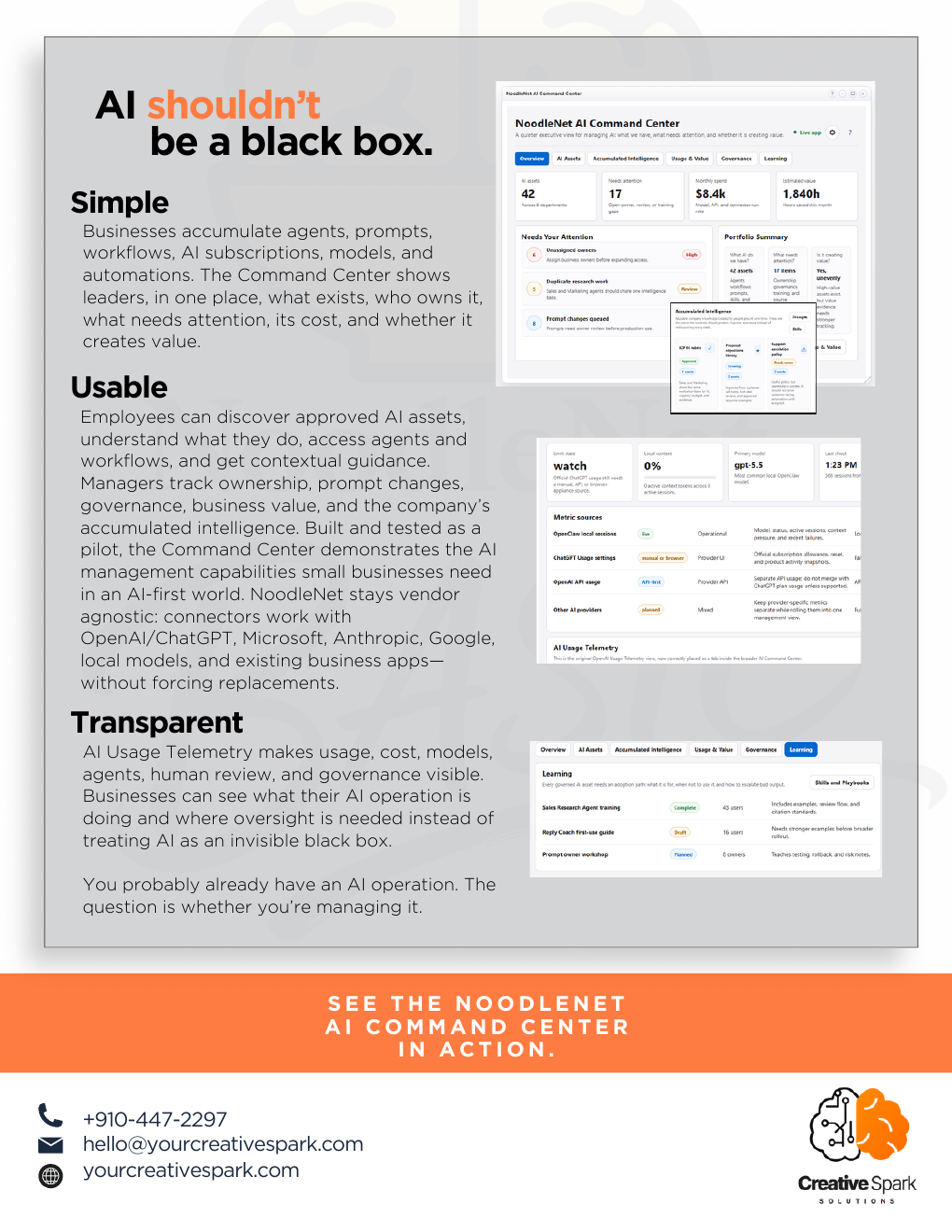
AI should not be a black box.
If it is becoming part of the workforce, it needs the same basic clarity we expect from the rest of the operation: ownership, purpose, boundaries, oversight, and evidence of value.
Download the two-page NoodleNet AI Command Center management brief.